AI is everywhere in our pipeline, and we’re not going to be coy about it. AI plans, it sorts, it cleans up audio, it writes code that makes things move. The sorting rule isn’t a philosophy, it’s just how the day works: If a bored intern could do it, AI does it, and if it needs taste—story structure, motion design, the voice a piece speaks in, the final cut—a human does it. The interesting part isn’t which AI tools we use—you can subscribe to the same ones we can. It’s what we’ve used them to build and the tools were never the hard part anyway.
The rule
Start with the word intern, because it’s carrying weight. Ours is tireless and genuinely useful. It will log 300 clips overnight, transcribe every one, and have the pile sorted before anyone’s first coffee. It will also, given half a chance, letterspace your logo like a ransom note.
That’s the line. Not difficulty. Plenty of what AI does for us is hard. Not fear, either. Taste. Story, motion design, voice, the final cut—a human makes those here, on every project, no exceptions. AI is a tool the way a camera is a tool, and a camera has never made a video.
And before anyone concludes they could run this play in-house with the same subscriptions: AI wasn’t in the meeting. It doesn’t have your roadmap, or the aside your SME made on a Tuesday call, or the thing your PMM said off-camera about what customers really complain about. AI is only ever as good as the context handed to it, and we’re the ones in the room collecting it.
A note on how we handle your material. We use paid business tiers where client data isn’t used to train models. Pre-release product material never goes into third-party AI tools. Period. Much of the processing happens locally, inside the editing applications, so footage never leaves our machines. Nothing generative ships without your approval. The shortest version: We use AI tools. We don’t let AI do the work for us.
We use AI to build our own tools
The fastest way to make a team more productive—and, it turns out, more creative—is to hand it a tool that fits. Not one that mostly fits. One that works the way you already work, so no part of the day gets spent working around the software.
Ask a creative whether they own a tool like that and you’ll mostly get a laugh. Those tools don’t exist commercially. Studios like ours aren’t a big enough market to build them for. Plus, we're very particular.
So, we build our own. That used to be a fantasy. Building software is a project, and a studio our size doesn’t run software projects. AI is what moved it from fantasy to Tuesday.
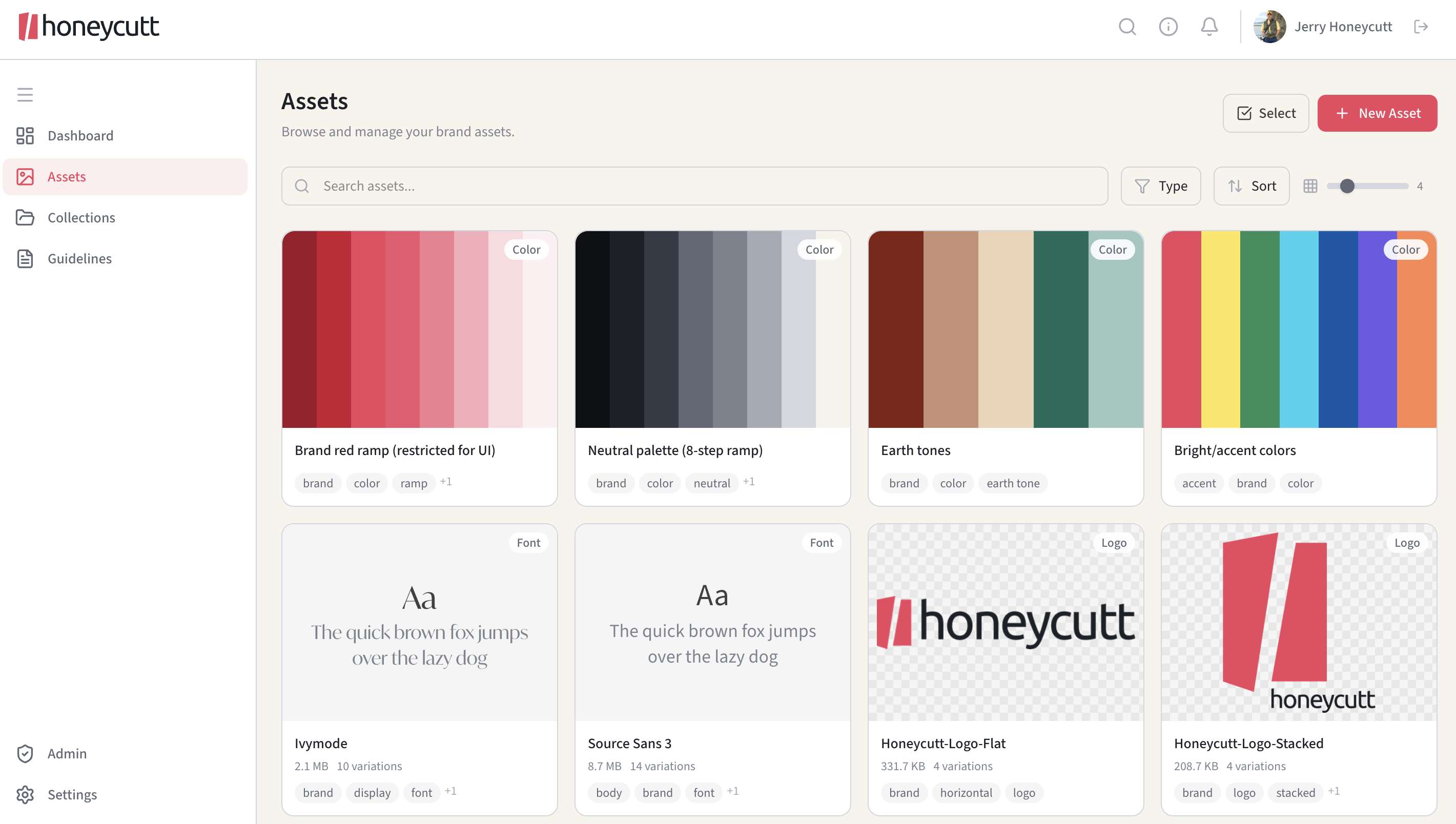
Our internal brand asset portal is an example: vibe-coded and thoroughly unglamorous (although it has a terrific UX), holding guidelines, logos, fonts, and color values in one place. Nobody outside this company logs in to it. It exists because of what happens without it: an editor two weeks from delivery building a frame from a stale logo somebody saved to a desktop last March. Ouch.
There are custom panels inside After Effects and Premiere, created by us, for the thing a project needs done a hundred times: restyling every callout after your product’s UI shifts, rebuilding the same lower-third across twelve videos. An artist makes the call once and the panel repeats it ninety-nine times.
And expressions: A line of code that drives a property, so a bar redraws itself when the number changes and a callout stays pinned to a moving cursor rather than keyframed by hand. An animator decides the behavior, AI drafts the code, the animator tunes it—a prompt and a test render instead of an afternoon of squinting. An afternoon back per shot.
Then there’s the half that never opens Adobe at all. Agents and skills for the parts of the job that happen long before anyone touches a timeline. Internal production tools: a storyboard and script editor shaped around the way we actually work rather than the way a product manager guessed we might. None of it would survive a demo at a software conference. All of it saves an afternoon a week, which compounds.
And because we own them, they move when we do. Need a new feature in the script editor to support a client's needs? Done same day.
Actual AI products of our own? On the horizon. Not this year. But we definitely have plans to develop AI tools that support our clients in the best ways possible.
Great at photoreal. No taste for motion graphics.
Point AI at a photograph and it’s astonishing. Background removal, canvas expansion when a shot is framed a hair too tight, upscaling, frame interpolation to smooth motion that wasn’t shot smoothly—it all lives in the tools now and takes seconds.
Audio is the best one. A room with a hum in it, a SME who recorded on a laptop mic with a glass wall behind them, an hour before the deadline: AI repair takes that from a C- to a solid B+. Not a Grammy. A pulse.
But point AI at motion graphics and it falls apart, predictably. Easing is wrong, so motion lands with a disappointing thud. Composition is arbitrary. Elements sit where they sit for no reason. Style drifts shot to shot, so every frame is plausible alone and the sequence looks like four different projects. And you rarely get what you pictured. It hands you a lower-third that arrives late, wearing the wrong font, and sits down in the middle of frame.
None of that is the real problem. The real problem is that the results always look like everyone else’s work. A model has seen everything, so it regresses toward the average of everything; and average is exactly what you’re paying to escape. You’ve sat through a competitor’s video that could have been yours with the logo swapped. Craft problem on the surface, brand problem underneath. We don’t ship it.
Which is the pattern. AI gets to 80% astonishingly fast, and 80% is where video goes to die. The last 20% is timing, restraint, the frame you hold two beats longer than feels comfortable, and it’s the only part that makes a thing yours.
The voice on your finished video is a person
The voice on your finished video is a real human narrator, cast on purpose. If we ever can’t cast one, you will know before you see the cut. Because, we can hear AI voiceover instantly. Your customers can too.
The reason it holds is small and hard to fake. AI voiceover never stumbles. It never leans on the wrong word and recovers. It never sounds like it just thought of something. Humans do all three, and a good narrator does them on purpose. That’s how you know someone is in there.
We’d also rather our voice-artist friends kept the work. That’s a preference and a practice, not a moral position.
But, yes. We’ve used synthetic voice on a handful of projects where the turnaround was measured in minutes and booking a human wasn’t possible. For example, when we're on an event deadline and the leadership team is making frequent script changes all the way to the end. (If you know, you know.) In these rare circumstances, using a synthetic voice is unavoidable.
The unglamorous wins
The boring stuff is where AI quietly changed our week:
- Production planning. A shot list, location maps, and a crew roster in, a shooting schedule out.
- Accessibility review. Captions, contrast, etc. flagged before your compliance reviewer finds them.
- Footage indexing. Every take transcribed and searchable, so finding the good one takes a minute, not an afternoon.
- Timeline cleanup. The ums, the dead air, the eleven seconds where everyone waited for a plane to pass.
- Deliverables. One source turned into every cutdown, aspect ratio, and social media post the launch needs. Any source that produces just one video is a rounding error.
The one that surprised us: brainstorming
We expected AI to make us faster. We didn’t expect it to make us more creative, which is an irritating thing for a creative studio to admit.
The mechanism is simple. AI is a tireless generator of mediocre ideas, and mediocre ideas are the compost good ones grow in. We ask for concepts and get back a pile—mostly useless, a few we’d never have considered, occasionally one that reframes the piece. It works at every altitude, from the big idea down to the way one line of script lands. Somebody still has to know which ones are good, and the pile is only as good as what we walked into the room and learned.
About the jobs question
Start with what it means for you. The person who used to spend two days nudging keyframes and markers now spends those two days giving notes on your video. Fewer hands on the mouse, more hands on the wheel.
For us it’s a job change, not a job loss. Directing the tool that does the mechanical part is still directing, and there’s more of that to do.
Which raises the question a buyer is already asking: So is it cheaper? Short answer: no, you get more. The time comes back as output rather than a smaller invoice: more versions, more cutdowns, more by-products from the same shoot day, more passes on the frames that matter. Deadlines that used to be impossible are now merely tight, which is worth something to a launch date that’s already moved twice.
What this position costs us
Being honest about the intern means admitting what the rule costs, so here it is.
We are slower than a studio that lets the model finish the job, and on some bids we are more expensive. When a competitor generates the footage, the voice, and the b-roll in an afternoon, they can quote a number we cannot match. We lose work over this. Not often, and not the work we want, but it happens, and pretending otherwise would be the kind of claim this post exists to avoid.
The reason we hold the line is that the market is already saturated with the alternative. 95% of B2B marketers now use AI somewhere in their workflow, and only 39% report improved content performance (Content Marketing Institute, B2B Content and Marketing Trends: Insights for 2026, n=1,015). Everybody adopted the tool. Most of them did not get better.
Your audience is also further ahead than the pitch decks assume. Nearly 83% of consumers say they have watched a video they suspected was AI-generated, and 36% say AI-generated video lowers their trust in a brand (Animoto, 2026 State of Video Report, 460 qualified participants, surveyed September 2025). Roughly a third of the people you spent the budget to reach would think less of you for the shortcut. That is a strange thing to buy on purpose.
What’s actually hard to replace
Plenty of studios have creative chops. Plenty of IT shops understand your product. The rare thing—the thing AI is furthest from doing—is people who genuinely follow what your software does and can make it look like something. Intern work to the intern, taste to a person, and if we’ve done this right you won’t be able to tell which was which. You’ll just see something good, and the pixels will quietly take all the credit.