We ran two channel reviews this week, for two software companies in two different markets. Different products, different buyers, different competitors. Both found the same thing: the video that worked best was the one the channel had stopped making. Yours might turn up something else entirely, and that’s the point of looking.
Nobody made a bad call. Teams get busy, events need covering, and a webinar clip is easier to publish than a new explainer. Each choice made sense on the day. But nobody had lined up the numbers, so nobody saw the median slide.
At Honeycutt Inc., lining up the numbers is the whole job of a channel review. It’s free, and it usually ends with a short list of fixes you can make yourself in an afternoon. Here’s what goes into one, and what those two found.
What a channel review is
A channel review answers two questions: why does a channel get the reach it gets; and what can its owners fix this afternoon and this quarter?
We pick three to five comparable channels, usually direct competitors, an independent creator or two who cover the same topics, and at least one channel that punches above its size. Then we read every number off the live pages: subscribers or followers, median views on the 30 most recent uploads, cadence, length, titles, thumbnails, search position for the questions buyers type, and the settings nobody checks, like comments, end screens, and captions.
Then we watch. We’re a video studio, so we study the opening seconds of your biggest hits and your newest uploads. What’s on screen at three seconds? A person, a logo, or a loading bar in a tuxedo?
Before anything reaches you, a second, independent pass collects every figure again without seeing the first set. Anything that doesn’t hold up gets cut. In these two reviews, that meant a handful of search results and three borderline videos, so none of those made it into the final reviews.
You get a written review to pass around and a short deck to present, in about a week.
Two channels, one pattern
The first channel’s best videos were six years old. Seven of its ten most-viewed videos came from 2019 and 2020, with a median of 20,193 views each, 159 times its median upload today. Each one answered a single question an IT pro types into YouTube before buying anything, in about four and a half minutes, with a person on camera saying the question in the first sentence. Then the channel stopped making that video. Its 30 latest uploads earned a median of 127 views, and the 30 before them, from 2023, earned 134. Three years, and the number never moved.
The same company runs a second channel that still makes that kind of video, and it tells the story in one picture.
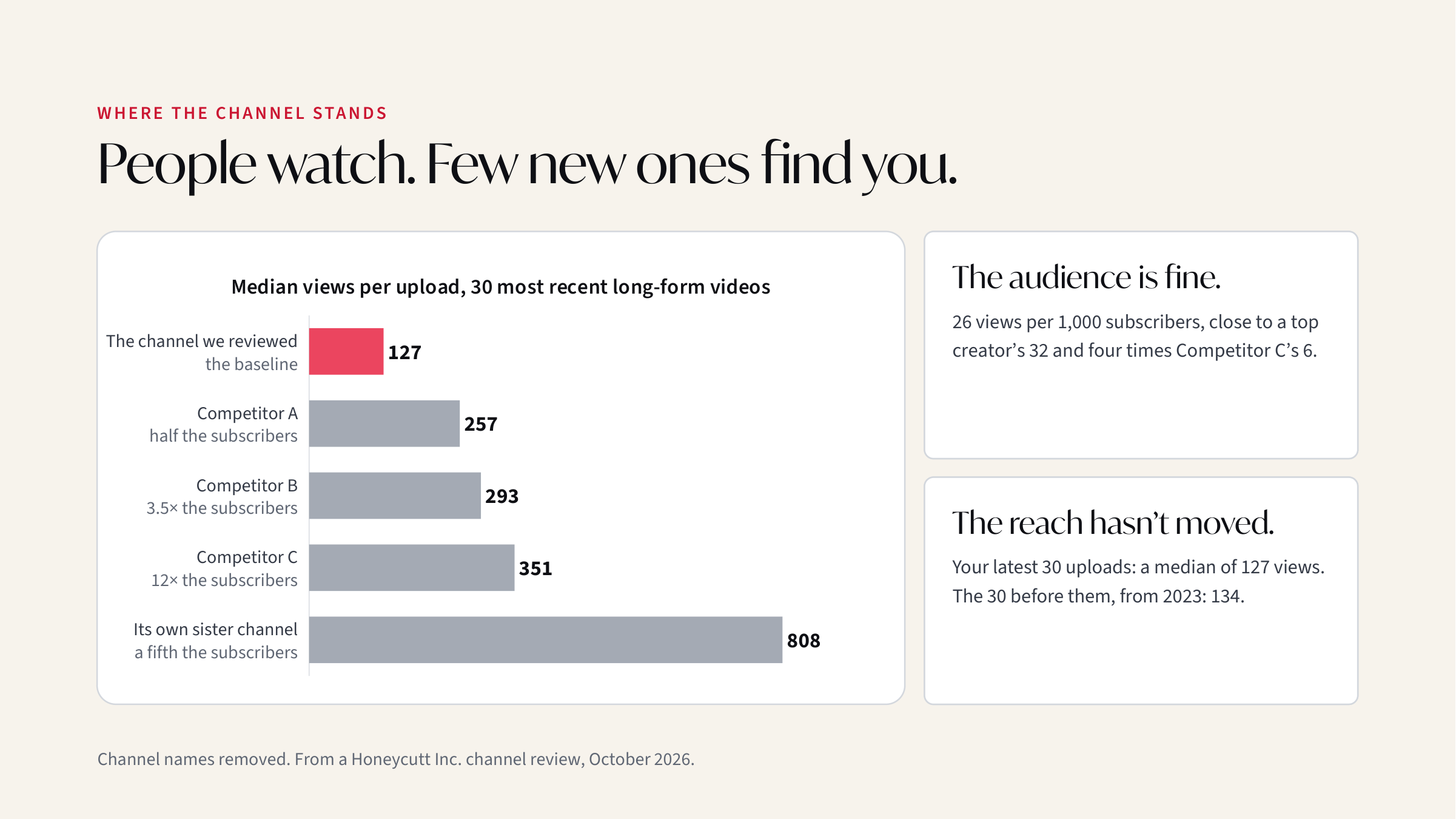
The sister channel has a fifth of the subscribers and earns six times the views per upload. Some of that comes from collaborating with a bigger channel, and we said so. But its format, length, and packaging are things the main channel could adopt tomorrow.
The second channel’s best videos were demos. Across its 60 latest uploads, the 20 that showed the product working earned a median of 144 views, and the other 40 earned 41. From January to March, 14 of its 30 uploads were product videos, and the median upload earned 99 views. From April on, 6 of 30 were, and the median fell to 46. The demos were replaced by short clips from a virtual summit, each opening mid-sentence over a four-person video-call grid. They earned 12 to 40 views.
Both channels had other things in common, too. Both had a show that had gone quiet, one for six weeks and one for five months, and a show that goes quiet looks like a show that ended. And both had small settings working against them. On the first channel, comments were off on 65 of the 69 videos we checked, including all ten all-time hits and their 246,913 views. The second had no end screens on any of its 60 latest uploads, and its automatic captions turned the company’s own name into a word that isn’t one.
One more thing we check: views that look bought. The second channel’s most-viewed video was a 48-second animation with 1.7 million views. Counts like that usually mean ads, so we set it aside. A median shouldn’t be fooled by a media budget, and neither should a review.
The afternoon list
Every review ends with a table we call “Do this month,” and it has one rule: nothing on it needs budget, new production, or sign-off beyond the people who run the channel. Here’s what made the lists this time.
- Open with the question, not the logo. The hits said the question at 0:00. The recent uploads opened on a logo animation or in the middle of someone’s answer. YouTube’s own editor can trim a clip without a re-upload. An hour.
- Put the series name in the title. One episode ranked first on YouTube for its topic, but nobody could search for the next one. Fifteen minutes.
- Link to your channel from your own website. The episode pages linked to four podcast apps and not to YouTube. Fifteen minutes.
- Turn comments back on, and name an owner. An hour, then a weekly check.
- Add end screens to your demos. Otherwise a viewer who finishes one is handed to YouTube’s suggestions instead of your next demo. Two hours.
- Put your best recent video at the top of the channel. One home page led with a 14-month-old, 34-second promo with 706 views. Fifteen minutes.
- Announce the next episode. One meeting.
Seven fixes, zero dollars, and about an afternoon of work. You can take that list and run with it, and plenty of teams do. We’d still call that a good review.
Where we come in
The afternoon list fixes the packaging. The bigger wins need production, and that’s the part we’d love to help with. For these two channels, the plans for the quarter looked a lot alike.
- Cut the long sessions into standalone answers. Each episode or event session becomes several videos of a few minutes each, titled as the question it answers. The Shorts cut from the first channel’s episodes earned 489 views between all six. A 40-second clip of a 32-minute conversation can tease an idea, but it can’t answer anyone’s question.
- Bring back the format that worked. One-question explainers for the first channel, product videos for the second. Each back catalog had already shown what earns views.
- Build one thumbnail system. A person, three to five big words, and one color per topic, so a buyer can tell what a video is about from a thumbnail the size of a postage stamp.
- Measure against your own best, and say so if it misses. For the second channel, the target was its own first-quarter median of 99 views per upload. It isn’t a benchmark we invented. It’s a number the channel already earned, back when it made more of the video that works. If we don’t hit it, you’ll hear it from us first.
With read access to YouTube Studio, we also report impressions, click-through rate, and view duration, which show whether the new packaging is earning the click.
LinkedIn too
Everything above works on a LinkedIn company page, with different measures. LinkedIn doesn’t show impressions publicly, so we measure engagement per 1,000 followers, posts per week, the format mix, and how native video performs against links. We also read every hook, the text before “…see more,” because that line decides whether anyone reads the rest.
Get your free review
Send us your YouTube channel or LinkedIn page through our contact page. Tell us who you think your competitors are and the two or three questions your buyers type into a search bar. We’ll do the rest, and you’ll have the review in about a week.
It costs nothing, and the afternoon list is yours whether we ever work together or not. Whatever’s holding your channel back, it’s usually already in the numbers. We’ll help you find it, and then help you fix it.